
I’d be lying if I said I first started listening to Alicia Witt because of her music. In fact, like many, my introduction to Witt came through her acting career. From her debut as Alia Atreides in David Lynch’s Dune, to her now cult-classic turn as a scream queen in the ’90s slasher Urban Legend, and standout roles in Cybill, The Walking Dead, Twin Peaks and, more recently, Longlegs, Witt has been a familiar face in films and television that don’t always walk the conventional line.
There’s always been something slightly left field about the projects she’s chosen. A willingness to step outside the ordinary, to embrace the strange and occasionally unsettling. With a few exceptions, her career has followed a path that feels very much her own. And, as it turns out, her music isn’t all that different.
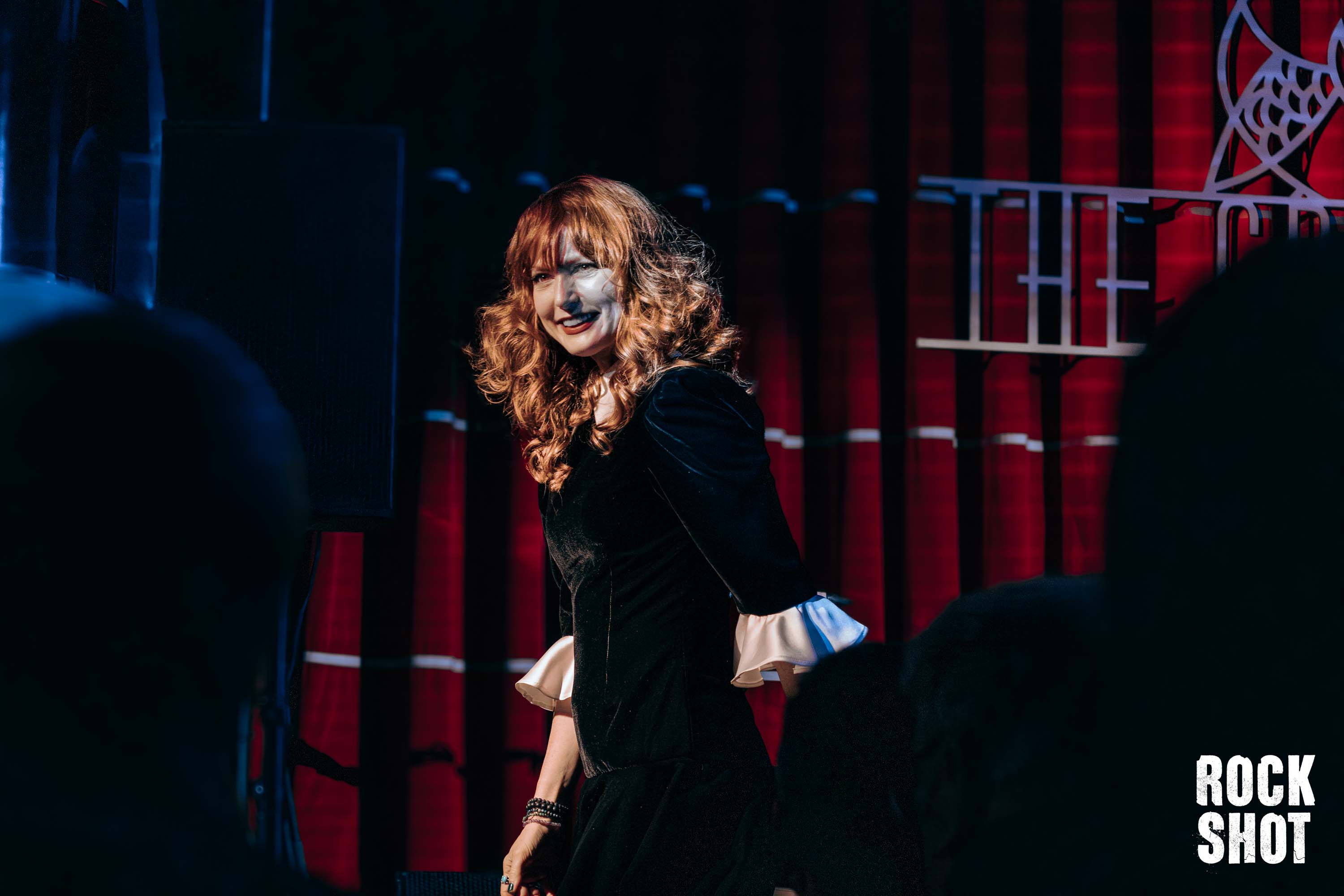
Alicia Witt @ Crazy Coqs
Since her first musical release in 2009, Witt has quietly built a back catalogue of playful, thoughtful and often dreamlike songs. But her latest album, Between Heaven and Earth, feels like something altogether more personal. Something that doesn’t just reflect her musical abilities but perhaps offers a glimpse into her very soul. And at the centre of it all is David Lynch.
Lynch wasn’t simply the director who gave Witt her first acting role at the age of seven. He became a mentor, a friend and a guiding presence throughout her life. Their relationship continued right up until his passing in January 2025, and it’s that connection, along with the belief that some relationships transcend the physical world, that forms the heart of this record.
Lynch, of course, was an auteur in the truest sense. A filmmaker who seemed less interested in explaining his visions than inviting audiences to lose themselves inside them. His work existed somewhere between dreams and reality, where meaning wasn’t necessarily something to be understood, but something to be felt. And, in many ways, that’s exactly what Witt has created here. So, when the opportunity came to see Alicia Witt perform Between Heaven and Earth at London’s Crazy Coqs, it was one I simply couldn’t miss.
Tucked away beneath Brasserie Zédel in the heart of Soho, Crazy Coqs is something of a hidden gem. An intimate, Art Deco-clad room that feels almost removed from the bustling streets above. With its low lighting, close-set tables and tiny stage, it was difficult to imagine a more fitting venue for an evening dedicated to music, memories and the magic of David Lynch.
The stage itself was wonderfully understated. A piano, double bassist Linus Fenton, guitarist Joe Herbert and Witt’s voice. Nothing more was needed. Witt, dressed in an elegant creation by British eveningwear label State of Dress, looked perfectly at home beneath the soft glow of the Crazy Coqs spotlight.
The audience was an interesting mix of devoted fans and faces from the world of film, with another scream queen amongst those in attendance. But as the house lights dimmed, everyone’s attention turned towards the solitary figure at the piano. And almost immediately, the room seemed to drift somewhere else.
There’s something distinctly ethereal about Alicia Witt. Not simply in her appearance or the delicate way she carries herself, but in the manner in which she speaks. Her stories seem to float rather than follow any conventional structure, taking little detours before somehow finding their way perfectly into the next song.
Opening with Love Anyway, Witt began an evening that would prove as much about storytelling as it was about music. Throughout the performance, she offered deeply personal introductions to the songs, often sharing memories of Lynch and the moments that inspired the album. At times these stories were playful, at others profoundly moving, and occasionally the emotion caught up with her, bringing tears to her eyes.
One particular story concerned what would become her final meeting with Lynch. Over coffee, the pair had laughed about the idea of wearing a smile like an umbrella against the rain. Witt recalled joking about catching a mouthful of rain, something that had amused Lynch enormously. It was a wonderfully peculiar little memory, the sort of seemingly inconsequential exchange that becomes infinitely more precious when the person you shared it with is no longer there. The laughter in the room slowly gave way to silence as Witt explained the significance of that final meeting.
And then came the music. Songs such as Between Heaven and Earth, Artifacts and Kindred unfolded with a gentle, almost hypnotic quality. Witt’s piano playing was effortlessly fluid, her fingers moving across the keys as naturally as breathing. There was nothing showy about her performance, no unnecessary flourishes or attempts to impress. Instead, every note seemed to serve the emotion of the song.
Her accompanying musicians, bassist Linus Fenton and guitarist Joe Herbert, brought wonderful texture to the arrangements. The cello added a haunting quality, occasionally drifting beneath Witt’s voice like something from a half-remembered dream. The guitar provided a subtle warmth, allowing the music to expand without ever disturbing the intimacy of the room. Remarkably, the pair delivered this incredible accompaniment with absolutely no rehearsal, making their seemingly effortless chemistry with Witt all the more impressive.
At one point, Witt spoke about attending Lynch’s memorial and discovering that others who had known him shared her extraordinary sense that he was somehow still present. That despite his passing, his influence continued to guide them, almost as if he were still directing events from somewhere beyond. It’s a beautiful thought, and one that would become something of a recurring theme throughout the evening. Not every song was about Lynch, however.
Introducing Freeze Frame, Witt spoke of another gentleman entirely. Someone with whom she felt a connection, but whose life had simply unfolded at the wrong time. She wondered aloud whether, had he been born a little later or she a little earlier, something more might have developed between them.
But sometimes life doesn’t quite work out that way. And so, rather wonderfully, all that remains of what might have been is a song. It was these little moments that made the performance so engaging. Witt wasn’t simply introducing tracks from an album; she was allowing the audience into the memories, relationships and fleeting encounters that had shaped them.
Midway through the evening, she stepped away from the piano and took to the microphone at the front of the stage. Freed from the keyboard, her performance became noticeably more physical, delivering a passionate and powerful vocal that demonstrated just how much range she possesses.
It was an important shift in the evening’s pace, a reminder that beneath the gentle storytelling and delicate piano arrangements is a formidable singer. Blue Moon, which Witt explained had quite literally been written on a blue moon, continued the evening’s otherworldly atmosphere, while Build Me a Dream, You Just Do and Undivided explored the album’s recurring themes of love, longing and connection.
There was a sense that the songs weren’t necessarily meant to provide answers. Rather, they were little windows into moments and emotions, allowing the listener to find their own meaning within them. And, much like Lynch’s films, the more you surrendered to the experience, the more rewarding it became.
As the evening moved towards its conclusion, Witt warmly thanked Linus Fenton and Joe Herbert, bidding them farewell before returning to the piano alone for the final songs. It felt entirely appropriate. Having spent the evening surrounded by these beautifully understated arrangements, there was something particularly affecting about stripping everything back to just Witt and her piano.
The closing stretch, including More and The Director, brought the relationship between Witt and Lynch into even sharper focus. The Director, in particular, felt like the emotional destination of the entire evening. A song born from Witt’s continuing sense of communication with her late friend, it seemed to exist somewhere between a tribute, a conversation and a farewell.
Although perhaps farewell isn’t quite the right word. Because if there was one thing Witt seemed determined to communicate throughout the evening, it was that love, friendship and inspiration don’t necessarily end when someone leaves this world. It’s a sentiment that could easily become overly sentimental in the wrong hands, but Witt delivered it with such sincerity that it was difficult not to be moved.
Of course, there was still one rather unexpected guest waiting in the wings. With the main performance complete, Witt introduced Ernest, her dog, who had travelled all the way from Nashville to join her in London. Ernest, evidently no stranger to his owner’s performances, seemed entirely unfazed by his surroundings, settling himself quietly on stage while Witt invited requests from the audience. What followed was a playful little medley of songs from her wider catalogue, with I’m Not Ready for Christmas, from the Hallmark film of the same name, proving a particular crowd favourite.
After such an emotionally charged evening, it was a lovely way to bring everyone gently back down to earth. A little humour, a little spontaneity and a reminder that, for all the deeply personal subject matter, Witt clearly enjoys sharing her music with an audience. And then, almost as suddenly as it had begun, the evening was over. I found myself sitting there for a few moments, not entirely sure what I’d just witnessed. It certainly wasn’t a conventional concert.
There were no big theatrical moments, no elaborate production and no desperate attempts to win over the crowd. Instead, we’d been invited into Alicia Witt‘s world for an hour or so, somewhere where memories become melodies and stories seem to drift effortlessly into songs. There’s a vulnerability to Between Heaven and Earth that makes it rather special. Produced by Joe Henry, the album feels less like a collection of individual tracks and more like one continuous meditation on love, loss and the connections that survive both.
And in celebrating David Lynch, Witt has somehow managed to create something that feels remarkably close to his own artistic spirit. Like Lynch’s films, this music may not be for everyone. Some will undoubtedly find its unhurried pace and spiritual themes a little difficult to connect with. Others might wish for more conventional song structures or something with a little more bite. But those willing to surrender themselves to Witt’s world, to allow the music and stories to wash over them without constantly searching for an explanation, will discover something rather wonderful.
Afterwards, I stopped to speak with Witt as she warmly greeted friends and fans. What struck me was how little the person differed from the performer. That same dreamy, slightly otherworldly personality seemed to continue long after she’d left the stage. There was no sense of a character being switched off once the spotlight had faded.
Perhaps that’s what made the evening feel so genuine. What we’d witnessed wasn’t simply a performance of her latest record. It was an artist sharing something deeply personal, in the hope that perhaps a little of its meaning might find its way into somebody else’s life. And if that sounds a little whimsical, well, perhaps that’s entirely the point.
As I said, I’m still not altogether sure what I experienced at Crazy Coqs on that Monday night. But much like walking out of a David Lynch film, I found myself thinking about it long afterwards. Replaying the stories, recalling little moments and wondering whether I’d understood everything I’d been invited to experience. And ultimately, I’m not sure I needed to. Because sometimes the magic isn’t in understanding what you’ve witnessed. It’s simply in allowing yourself to experience it. And given the opportunity, I’d happily sit back and let Alicia Witt work that magic all over again.


Live review & photography of Alicia Witt @ Crazy Coqs, London, by Henry Finnegan on 19th October 2026. Instagram: @finneganfoto | Facebook: @finneganfoto
The Lemonheads Find Fragility And Warm Nostalgia At Roadmender


Share Thing