
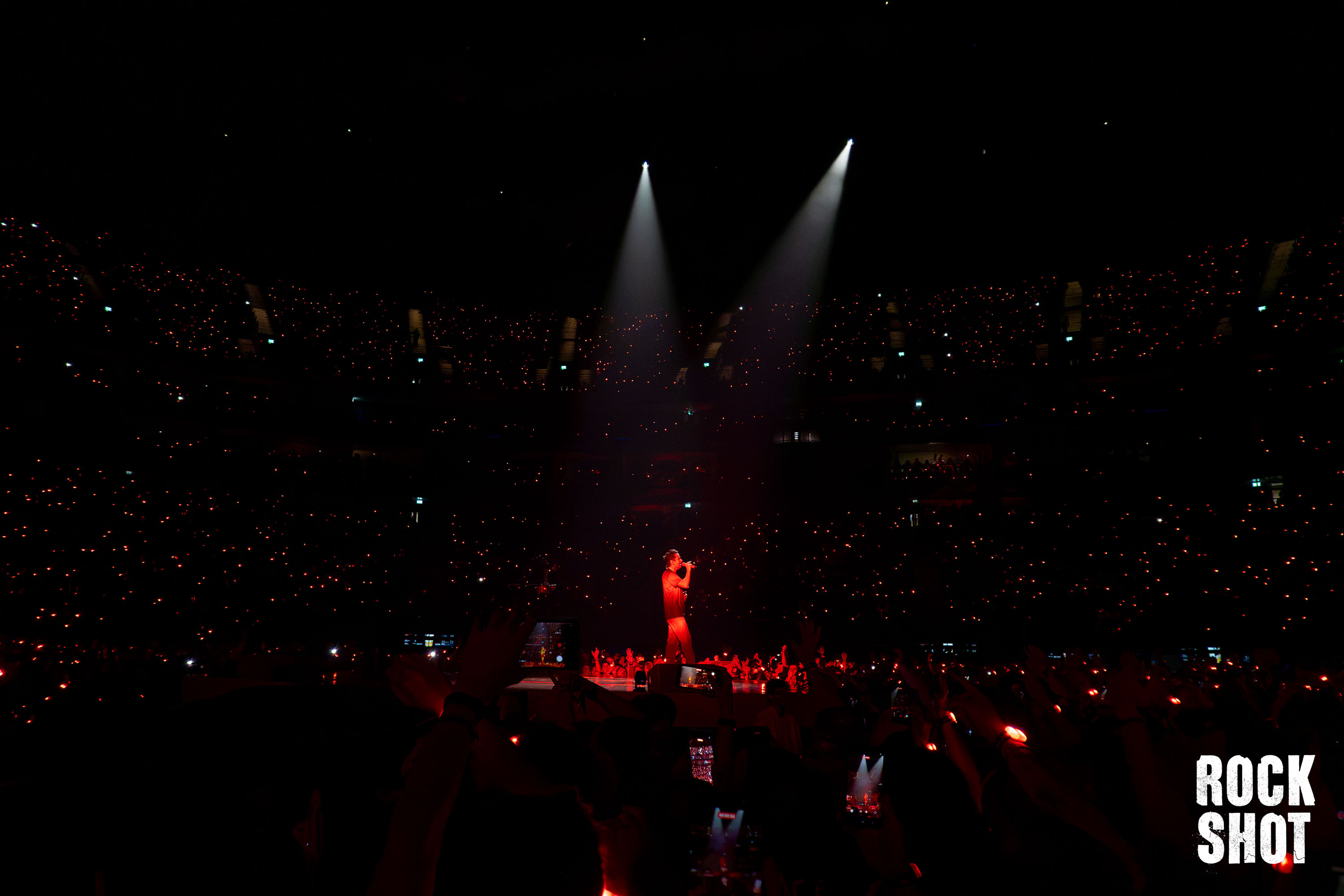
Muse turned The O2 Arena into a science-fiction spectacle on Sunday 15th November 2026, blending robotic performers, futuristic staging and an ambitious production with the colossal riffs and anthems that have made them one of Britain’s most formidable live bands. But while their tenth album, The Wow! Signal, provides the evening’s central theme, it is the trio’s musical firepower that ultimately makes this first of two London shows so compelling.
Muse @ The O2

Inspired by the mysterious radio transmission detected in 1977, the production explores the unknown through technology, artificial intelligence and striking visual effects. Yet the Teignmouth, Devon-hailing trio never allow the concept to overshadow the music. With Matt Bellamy, Chris Wolstenholme and Dominic Howard at the centre, this is an arena show that looks to the future while drawing strength from a catalogue packed with enduring classics.
Opening proceedings are London four-piece Bitterpearl, followed by American alternative rockers Dead Poet Society. Formed in Boston in 2013, the latter deliver a muscular set of grunge-influenced alternative rock. Frontman Jack Underkofler, guitarist Jack Collins, bassist Dylan Brenner and drummer Will Goodroad bring plenty of energy to the stage, setting the scene for the main event.
As anticipation builds, the enormous backdrop screen displays a date: August 15, 1977. It marks the date of the famous Wow! Signal, a mysterious 72-second radio transmission detected by Ohio State University’s Big Ear radio telescope. The unexplained phenomenon lends its name to the band’s latest album and provides the conceptual framework for tonight’s production.
The stage is an impressive feat of engineering. Two runways extend from either end of the main platform, converging into a catwalk that reaches deep into the arena before terminating at a hexagonal B-stage. A limited standing area within the structure gives a fortunate handful of fans an unusually close vantage point, while the extended configuration allows the band to reach different sections of the venue.
The opening moments are striking. Matt Bellamy rises from within the B-stage hexagon as the band launch into, well, Hexagons. Illuminated hexagons descend from the ceiling, framing the frontman as Chris Wolstenholme moves towards the left runway and Dominic Howard takes position on the right, alternating between a smaller drum kit and his full setup on the main-stage riser. It’s hard to know where to look, it’s already sensory overload just seconds into the show.
Muse @ The O2

The Sickness In You & I raises the tempo, crunchy guitars and pounding beats underpinning Bellamy’s distinctive falsetto. Above the main stage, a gigantic three-dimensional waveform representing the Wow! Signal itself descends from the ceiling, resembling an enormous illuminated space doughnut. More of The Wow! Signal follows with Unravelling, its combination of electronic textures, soaring guitars and storming riffs demonstrating how comfortably the newer material sits alongside the band’s established catalogue.
“Thank you Londoooooon!” Bellamy screams before the band move into an Absolution double-header. An atmospheric Interlude introduces Hysteria, and Wolstenholme marches down the catwalk towards the B-stage to deliver that unmistakable bassline. His illuminated fret markers make the instrument particularly striking, while Bellamy’s guitar cuts through the arena before the song settles into its familiar, irresistible rhythm.
Muse @ The O2

Cryogen brings another taste of the new album, its distinctive opening riff quickly establishing itself, before Supermassive Black Hole takes over. An extended, ominous introduction builds anticipation before the 2006 single erupts, its dark grooves, falsetto vocals and explosive guitar work proving as infectious as ever. “You guys are awesooooooome!” Bellamy shouts, before adding, “You can tell I’ve been in America when I say shit like that!”
He then catches himself while introducing the next song. “Let’s play Dark Side … Dark Forest,” he says, correcting himself with a chuckle. “There’s so much darkness in my life.” The band launch into The Dark Forest, another track from The Wow! Signal. Its gothic atmosphere, pulsing synths and screaming guitars draw the audience into its dark, cinematic world.
The evening takes an altogether more unconventional turn with the arrival of Ameca, Muse‘s humanoid robot, positioned towards the rear of the arena floor. Ameca takes over vocal duties for an abridged, reimagined version of Kill Or Be Killed, the band’s only contribution from 9th LP Will Of The People tonight. Bellamy is absent as Wolstenholme and Howard provide bass and drums over the electronic arrangement, while Ameca’s image appears on the enormous backdrop screen. It is a surreal interlude, but entirely in keeping with the show’s fascination with artificial intelligence and the relationship between humanity and technology.
Muse @ The O2

Bellamy returns as organ chords introduce Be With You. The audience joins in, their illuminated Coldplay-style Xylobands glowing red as the frontman makes his way along the runway towards the B-stage. Confetti cannons fire red ticker tape into the air, followed by long streamers launched above the crowd.
Ameca returns to take on the drill sergeant role for Drones cut [Drill Sergeant], prompting the familiar response of “Aye, sir!” before the band launch into Psycho. Its heavy, stomping rhythm gets the arena moving, with the robot continuing to provide the military-style commands throughout.
Muse @ The O2

“This is our 15th or 16th time playing here, someone said,” Bellamy declares. “We’re chasing Prince, we’re gonna get there, we’re gonna get there” he continues, referencing Prince’s legendary 21-night residency at the newly opened O2 Arena in 2007. Bellamy clearly has ambitions for Muse to challenge that record.
The opening refrain of Madness brings a change of pace, its pulsing synths and familiar vocal hook giving the 48-year-old frontman the opportunity to hand the chorus to his audience. He moves along the runway before unleashing the song’s extraordinary guitar solo, injecting a burst of instrumental firepower into an otherwise synth-driven composition. There is little opportunity to catch a breath before Bellamy begins teasing the opening of Plug In Baby, using the built-in Fuzz Factory effects on his distinctive Manson guitar. The familiar riff soon takes over, and the Origin Of Symmetry single becomes one of the night’s most exhilarating, bounce-along moments.
Muse @ The O2

An instrumental passage, Hanging In Victory Square, provides a brief change of pace before Wolstenholme’s soaring bass introduces Time Is Running Out. Another Absolution classic, it gives the audience another opportunity to take ownership of the chorus. The familiar introduction to Uprising follows, its distinctive electronic opening carrying an almost Doctor Who theme-like quality. The pounding rhythm soon takes over, and Bellamy needs only three words to set the tone: “Sing it London!” The response is immediate, with thousands of voices joining the chorus.
Before Knights Of Cydonia gets underway, Wolstenholme makes his way to the tip of the hexagonal B-stage stage, forgoing his bass guitar, to deliver Ennio Morricone’s Man With A Harmonica introduction. It is a familiar feature of the song’s live presentation, and he delivers it with characteristic precision. The ensuing galloping rhythm and explosive guitar work provide a thrilling showcase for the trio’s chemistry.
The electronic landscape returns with The 2nd Law: Isolated System. Howard’s pounding drums bring the arrangement to life before touring multi-instrumentalist Dan Lancaster‘s remix takes over. The Xylobands pulse in synchronisation across the arena, briefly transforming The O2 Arena into a gigantic electronic dancefloor.
Bellamy’s disappearance from the stage is soon explained as he re-emerges in a neon outfit, wearing illuminated glasses and an LED jacket for Nightshift Superstar. Lasers cut across the arena as the song unfolds, with Wolstenholme’s pulsing bass providing the driving force behind its infectious dance-rock arrangement. The trio then move to the B-stage, where an illuminated upright piano awaits Bellamy. He introduces the next passage with Rachmaninov’s Piano Concerto No. 2 before moving into an abbreviated instrumental rendition of Algorithm, from Simulation Theory. The band then move seamlessly into Undisclosed Desires, performing the entire song from the B-stage.
Muse @ The O2

At its conclusion, Howard and Wolstenholme return to the main platform, leaving Bellamy at the piano to introduce Prelude, from The 2nd Law. The instrumental passage builds anticipation before the unmistakable opening of Starlight arrives. “Sing it London!” Bellamy demands, dropping to his knees at the beginning of the runway as Wolstenholme strolls behind him, delivering the song’s instantly recognisable bassline. The audience carries the chorus in unison, creating an uplifting moment that demonstrates how Muse can connect with a crowd beyond the elaborate production.
The song concludes and the trio, joined by Lancaster, leave the stage. Above them, the space-doughnut remains suspended while concentric hexagons of white light illuminate the standing audience. The anticipation builds as the familiar introduction to Take A Bow emerges through the PA.
Muse @ The O2

Bellamy reappears from within the B-stage hexagon, rising as the structure elevates him. Kneeling to deliver the haunting opening verse, he creates an imposing silhouette before returning to the main stage to collect his guitar.
The song builds towards an immense closing crescendo, its electronic textures and increasingly powerful guitar work bringing the evening to a dramatic conclusion. The trio then take a lap around the hexagonal walkways, acknowledging their audience as the house lights come up.
For all the technology and elaborate choreography, the greatest achievement of Muse‘s production is that it never comes at the expense of the music. Bellamy remains a captivating frontman, combining his distinctive vocal range with guitar work that continues to define the band’s sound. Wolstenholme is an absolute powerhouse, his bass playing frequently taking centre stage, while Howard provides the rhythmic precision and explosive energy that underpin everything. Lancaster’s contribution further expands the band’s considerable sonic possibilities.
Crucially, the new material never feels out of place among the established favourites. The Wow! Signal receives a substantial airing, but its songs sit comfortably alongside the anthems that have defined Muse‘s career. The result is a show that looks firmly towards the future without losing sight of the band’s past.
For the first of their two nights at The O2 Arena, Muse deliver an ambitious and occasionally surreal performance that embraces the unknown while celebrating everything that has made them one of Britain’s most compelling live bands.
The Wow! Signal may remain an unexplained mystery, but there is nothing mysterious about Muse‘s ability to deliver an arena show of extraordinary scale. Ten albums into their career, they remain a band with the ambition, imagination and sheer musical firepower to make the impossible feel entirely possible.


Live review and photography of Muse @ The O2, London by Kalpesh Patel on 15th September 2026. Additional photography of Muse @ The O2, London by Kalpesh Patel on 16th September 2026.
Muse’s Supermassive O2 Arena Show Gives The Will Of The People What They Want


Share Thing